


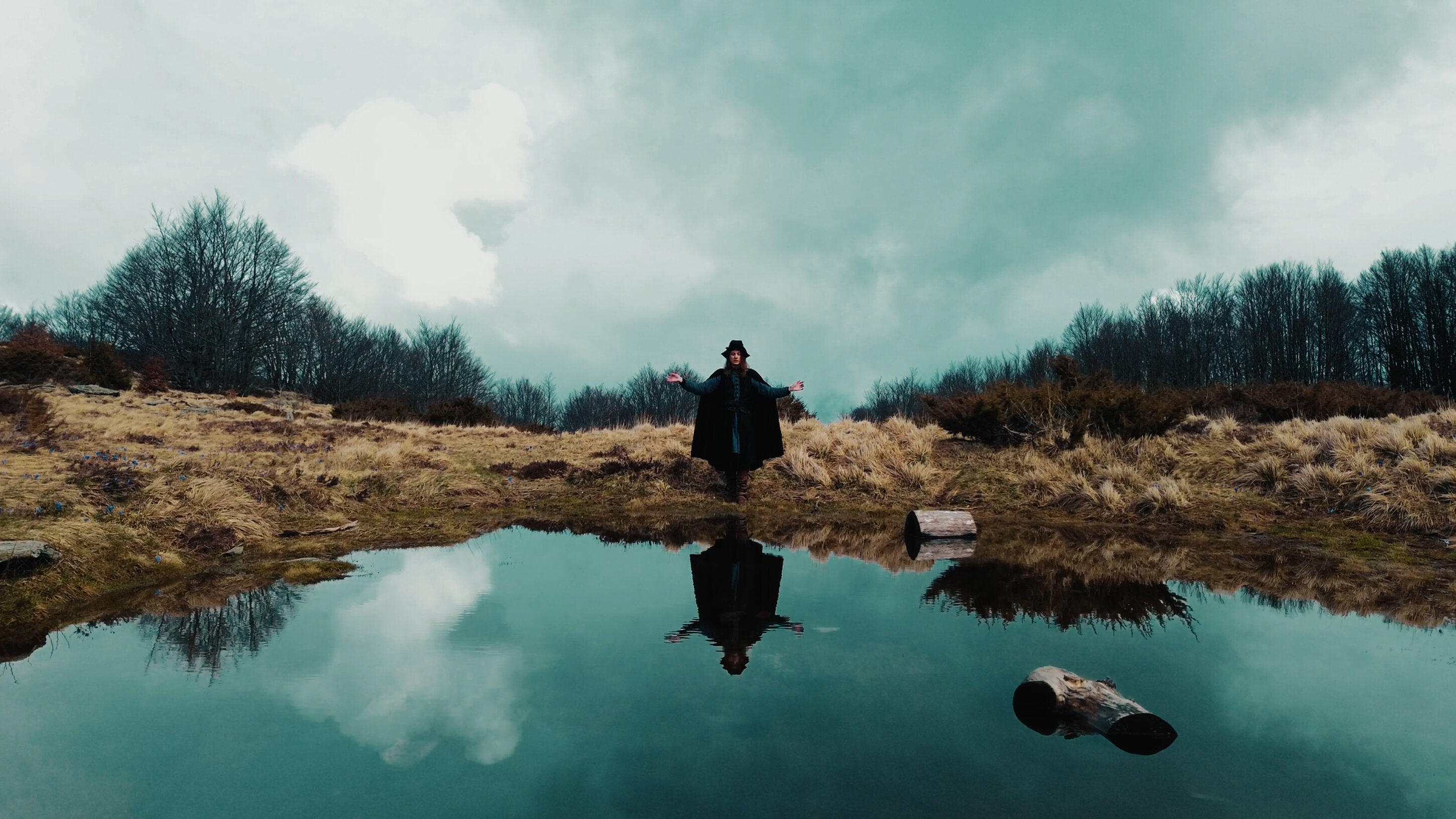
Out of sheer necessity, I coined the term Mythomagic; to clarify and index the influences on my novels, my music albums, and their synergistic relationship.
Mythomagic art uses typical elements of the magical-fantastic to delve deeper into the representation of external and internal reality, but there's much more.
On the one hand, there is Myth, and therefore mythopoiesis, where creative elements host the theater of archetypes, which, in the antechamber of the imaginal and conceptual world, envelop the psyche in a dance of correspondences with forms, energies, and sounds, with the essences of the vegetal, mineral, and animal kingdoms.
The mythomagic elements of narrative and dramaturgy, as well as of painting and music, are masks of the great archetypes: they preserve the symbolic-emotional potential of lyrical, visual, and sonic plots.
It has been widely illustrated how many voices from distant latitudes sing in unison the same fundamental stories, mines of truth in Indian, Sumerian, Celtic, Greek, Egyptian myths, and so on. Mythomagic literature has the same universality as alchemy, and it reinterprets these perpetually modern songs, renewing them through styles and languages.
In Mythomagy, the function of Myth operates constantly in disguise, faithful to the original dual meaning of art: Celebration and Transformation.
Celebration includes: art as a sacred offering, the pursuit of beauty (even in the depths of the soul), the aspiration to dissolve boundaries and temporary emancipation from the dictatorship of afflictions.
Transformation stems precisely from this desire to transcend, and therefore indicates the presence of opportunities for maturation, thanks to the theater of archetypes and their luminous and shadowy emanations.
Art heals us through catharsis and homeopathy: from shamanic rites to Euripides, from apotropaic fairy tales to the artificial writing of Atalanta Fugiens, from court epics to street ventriloquists, from sacred music to the ballads of irreverent troubadours, from Shakespeare to Mary Shelley, from Dante to Miyazaki.
Among magicians, imaginary animals, mythical ancestors, golems, vampires, fairies, angels, yakshas, demons, gods, aliens, chimeras, elemental spirits, and countless even more peculiar creatures, there are countless disguises of a single matrix: the human soul-genius, the bridge between us and the indivisible universal consciousness. This androgynous Guardian of the Threshold is similar to what alchemists call the Monad, the primary element for the Pythagoreans and Giordano Bruno.
The prerogative of mythomagic art is an invitation to reconciliation with the soul, proclaimed by the powerful and clear voice of symbols from the depths, which take on the form of characters, landscapes, narrative and sound plots.
To enable this, an author must recreate an immense and silent space within himself and channel himself, becoming a personal proscenium of the collective unconscious.
Continuing to analyze the term: alongside Myth I place Magic; but which one? There are two kinds of magic, but this has nothing to do with the classic division between good and evil.
Many years ago, Gabriele La Porta told me he didn't like the word Magic. His was an unusual position among lovers of Mystery, and it got me thinking a lot.
The Persian etymological root indicates a power to be mastered, which over the millennia will translate above all into the ability to reveal Nature, rather than subjugate it.
So if a Magician is a seeker of truth who seeks to reconcile the High and the Low (like the Hermetic and Anthroposophical mystery of the Magician), every Alchemist knows that to reveal means to veil doubly, and that in its deceptive being, the Path, indicates the right direction.
Mythomagical intends to embrace a Friendly Magic that governs the fantastic: that of the unusual, the marvelous, and the extraordinarily extraordinary. A magic that can amaze and enthusiastically engage; that, like a Bard, can strike every chord, entertaining, astonishing, frightening, moving, and reflecting. And in embracing these semantic and emotional meanings, Mythomagical takes into account that this "magic," imaginary or otherwise, is the mirror of the phenomenal world: it does not oppose the banality of mundane reality, but rather reveals its face.
In what sense does the magical-fantastic reveal the ordinary?
Lama Yeshe, in one of his nuggets of Tibetan wisdom, explained that "Magic is not the path to liberation," referring to the hopeful pursuit of supernatural and miraculous power. The most powerful magic has always been with us, in the middle ground between birth and death. Only with great meditative commitment can we, as amateurs, briefly free ourselves from the most terrible spell, that of Enemy Magic, the puppeteer who dominates our grasp on the (hallucinatory) perception of reality. The greatest illusion convinces us that things are permanent, bewitching us into blind and absolutist subservience to the senses, subjective impressions, emotions, and impulses, even if these only lead us to suffering. The most powerful magic is therefore Enemy Magic: the illusion that there is a self-existent "I" separate from the rest.
Friendly magic, whether fantastic, terrifying, or sublime, is an illusion that reveals itself, a mirror that points out the deception of what we call reality. In some ways, it is similar to the frightening apparitions described in the Tibetan Book of the Dead, which wish to shake the disembodied, to awaken them. A paradoxical reversal, right? It's no coincidence that the great sages and geniuses of history have had great insights by transcending ordinary states of consciousness and reversing their vision, like the Hanged Man of Odinic memory. And then, truth be told, the ordinary state of consciousness isn't ordinary at all, but is under the enchanting effect of constant deception, as mentioned earlier.
Ultimately, enemy magic, once recognized as such, can become the greatest ally for those further along the path. Friendly magic is a first elementary teacher, but it too, all things considered, pushes us towards overcoming dualisms.
Friendly magic, the magical-fantastic, has the power of Dreams, which speak the language of Myth, as Jung, Hillman, and many others before and after have taught. Dreams are as illusory as reality, with the difference that in the latter we can interact directly with other incarnate consciousnesses and significantly influence events, creating great suffering or purifying it. In short, in waking life we constantly produce highly effective karma.
Dreams, like reality—which, as mentioned, is pseudo-ordinary—are an equally valid and formative experience for consciousness. The images perceived and reproduced by the mind in waking life are no less subjective. The potential of dreams can be transported into waking life if we are aware of how illusory it is, and it is precisely in the waters of this mental state that David Lynch drew his ideas.
Dreams can become a crucible of Mythomagic, offering extraordinary potential, and the dreamer can explode like a big bang, fragmenting into linguistic codes at the service of the goddesses of ideas. An inspiring galaxy becomes the true author, dictating the works of a mythomagic artist, who uses the magic of dreams to heal the magic of deceptive and dictatorial reality. Like cures like. The mask that shatters masks. Catharsis and the Homeopathy of Art.
Thanks to the blanket, which by nature conceals things, it is possible to directly observe the light, without being dazzled by it.
To accomplish all this, an artist cannot do what he wants, but only what he can, because he will be the one to shape things after the initial mediumistic phase. He is the impresario of the theater of archetypes, and during the modeling, his skill, his craft, his technical mastery, and his culture emerge. Thus speaks the homeopath Samuele Yon in my novel Helughèa, the Winged Guardian:
"See Bard, to paraphrase the great Federico Fellini: I answered the call of my inner deity, projected into a kind of nebulous galaxy. I tried to recognize the signs and perform them mediumistically, in a state of grace. The text was written, I placed myself at its service, with the lightness of a ghost, the speed of a vampire, without preconceptions, so as not to contaminate the message. This tension between being a channel and being an author made me feel like I was ascending lightly and freely, and at the same time making an enormous effort, as if I were Atlas holding up the world, but on the wings of a bee."
The young Fedya states further:
"Whether it is a dream, reality, fantasy, in any dimension, Consciousness experiences, and it is a valid experience. Whether it is deluded or disappointed, it is luminous. Its nature is expansion. But it is up to us to choose."
Mythomagic clearly recalls Psychomagic. Jodorowsky is the last active witness to a certain twentieth century, that of the avant-garde, of the fresh cultural and esoteric legacies of the fin de siècle, of the blending of the sacred and the profane, the mysterious-multicultural and the popular. The manifesto of his therapeutic art has always been ultramodern, positioned between Gurdjieff and the simplified essence of shamanic ritual and Dionysian theater. I, too, tend to bring to the center the waters of many sources from which I have drawn. Spontaneously, in my telling, my humble understanding of Nagarjuna subtly yearns to flood the stories; sketches of Welsh narrative aspire to bathe the laps of the goddesses I have admired thanks to Marjia Gimbutas; streams of Robert Graves attempt to foam in the swamps of Faustism, whose monstrous emissaries reveal hearts of crystal.
There are no limits, only paths and many roots that intertwine in mythomagic activities: a rich and homogeneous terrain, a wind of philosophies that must inhabit stories lightly and naturally, to make them meaningful, educational, and powerful. I believe there is nothing more modern than being creative, although actual modernity works against everything I consider Art.
Mythomagic art is ravenous, it feeds incessantly on Wisdom and, after digesting it, it regurgitates its diamonds made of voices and emotions, of embodied utopias, and therefore far from the intellectualisms of this very article.
One of mythomagic's ambitions is to increasingly bring together Vastness and Essence, Complexity and Accessibility, Contemplation and Epicness, Form and Substance, Laughter and Crying, Gods and Demons, Play and the Philosophy of the Deep.
In mythomagic literature, the construction of a "fantastic" world is not invention, but discovery, and arises from contemplation, from offering all the space and material necessary for the imaginative call.
The narrative development on the horizontal temporal plane is dedicated to the search for a vertical time: that of intuition, inspiration, ecstasy, contemplation, synchronicity, ritual, healing. A time the Greeks called Kairos. A flowing and still inspiring breeze the bards call Awen. A meditative level that is like an empty canvas before infinite colors. It is the time of archetypes, which allows the profound beauty recognized by humans, by the guardian genius of their species, to flourish.
"Wave upon wave, step upon step, dream upon waking, everything is together on a vertical axis. A cosmic tree where Consciousness is an element that permeates space and time. This is the key to Vertical Time." Train yourself to contemplate this vision, which forges the impression of a luminous and eternal eclipse. In seeking this Gate, you will discover a qualitative, not quantitative, time that stands still like the spine of a Yogi.
(Helughèa, The Winged Guardian)
How is mythomagic art therapeutic? By immersing ourselves in mythomagic reading and listening, our mind oscillates between two opposing attitudes: attraction or repulsion, resonance or dissonance.
The theater of archetypes pushes us beyond the mere dualism of acceptance or rejection, as we experience the processes of thesis and antithesis.
It is just like in medicine, where it is possible to cure homeopathically, where like cures like; or allopathically, according to principles of opposition to symptoms, where opposites are cured by opposites.
Mythomagic art stages spiritual teachings, both grotesque and sublime; they manifest themselves in plots, where nothing is left to chance.
As a craftsman of imaginative and sonic art, I put everything I have at my disposal into a literary idea once it has captivated me. For this reason, my novels are rich in music, with varying levels of original integration between the two. It is a mythomagic and handcrafted multimedia music.
"Some wounds are incurable. The moment you accept their incurability, you've done much of the work, because you free yourself from the pain and frustration of not being able to heal."
(Helughèa, The Winged Guardian)